Turnaround on the horizon. History tells us that despite the situation, we are in for a boom and the best part of the…

Negative news is pouring in from all sides. But what if there is tangible evidence that the market could surge by the end of the year?!

History tells us that the 3 best months of the year are coming
September has once again drenched the markets in blood. But history has good news for the market: At the end of the year, prices usually rise. Even now, the stock market is entering the best three-month period of the calendar year ever.
Investors are already waiting for good news from the last of the strength. Financial markets have struggled this year with the Federal Reserve's series of interest rate hikes aimed at reducing inflation. Not to mention the ongoing shortage of raw materials and the aftermath of the war in Ukraine.
September - usually the worst month of the year for stocks - lived up to its reputation and was brutal. The Dow Jones Industrial Average fell into a bear market last week, joining two other major stock indices that have already fallen more than 20% from their recent highs, the S&P 500 and the Nasdaq Composite.

S&P 500 over the past month -9.15%
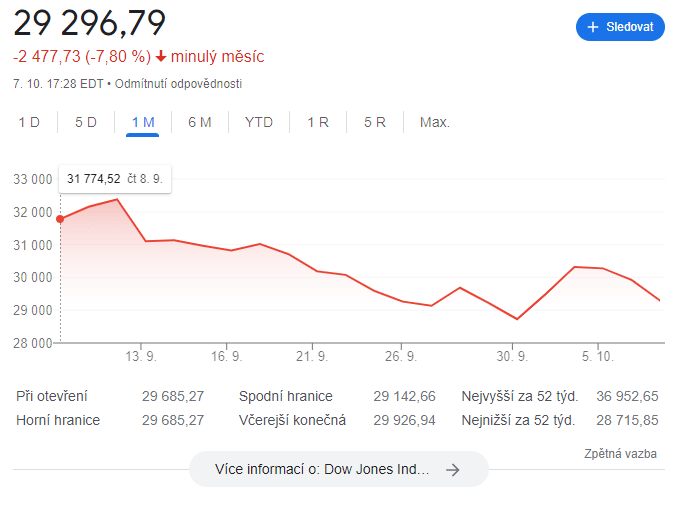
Dow Jones -7.80%
The good news for investors is that stocks tend to outperform in the last three months of the year after suffering in September.
We take a historical look at how stocks have traditionally performed in October, November and December - and what that may portend for the market at the end of 2022.
According to data since the mid-1940s, the S&P 500 index has jumped an average of about 0.9% in October, 1.4% in November and 1.6% in December. By comparison, the index lost an average of 0.6% in September.
Since 1945, the S&P 500 has risen in 60% of October, 66% of November and a whopping 77% of December.
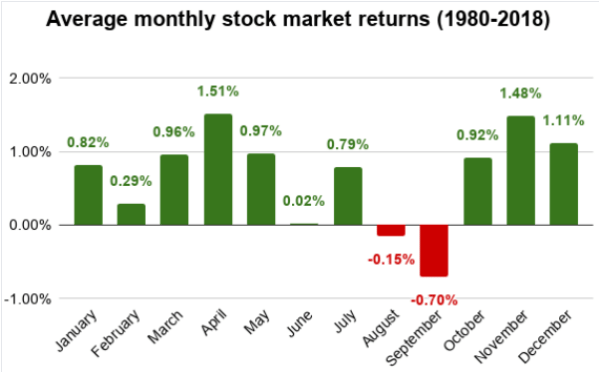
Slightly different figures are then found in the statistics of stockanalysis.com, they only looked at the years 1980 - 2018. Source.
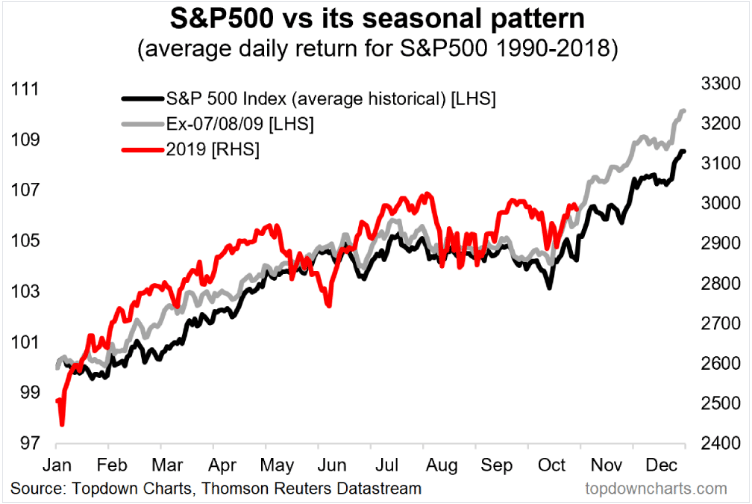
The index also tends to be very consistent when it comes to "copying" the historical average. Source
Of course - it is important to note that there is no guarantee that seasonal trends will hold this year. Moreover, the economy has been fraught with uncertainty lately. The Fed has signaled that it plans to continue raising rates as necessary to reduce inflation - a move that, understandably, also typically hurts the prices of financial assets like stocks, bonds and cryptocurrencies. Incidentally, many experts have criticized the Fed for this. Especially their hasty actions, which they say are too hasty. I describe one such criticism, for example, in this article:
In this particular case, the well-known billionaire Stanley Druckenmiller described the Fed's behaviour as "like a seesaw".
The Federal Reserve has made four interest rate hikes so far this year and is likely to raise them further to tame inflation. It looks like the next hike will be another 75 points.
From extreme to extreme. First brutal money printing and then the brakes stepped on (in the form of extreme tightening).
Could other factors be influencing the historical averages?
Yes, they can. Specifically, this year's US elections are relevant. As November approaches, elections (the so-called mid-terms) will be front and center in the states,and not just for voters: The last three months of the year in which mid-terms are held are historically good for the stock market.
"In election years, the end of the year tends to be very strong, while the first three quarters are usually weak. Let's not forget that markets hate uncertainty, and once the uncertainty associated with the election passes, seasonal strength sets in in November and December." Commented strategist Ryan Detrick.
According to CFRA Research, the S&P 500 Index has averaged monthly price gains of 2.5% in October, 2.4% in November and 1.4% in December during the election years since 1945 .
"So history says, but does not guarantee, that we could see a prolonged rebound from the current downturn," says CFRA Chief Investment Strategist Sam Stovall.
But don't be fooled - the volatility that investors are feeling in the market is probably not over yet. In fact, history tells us that October tends to be extremely volatile for stocks. While market timing can be tempting, it's usually not worth dealing with and trying to hit.
I would still take it as just a possibility that things will improve. After all, the important thing is not to lose sight of your long-term goal.
https://www.youtube.com/watch?v=lLtma2OP_as
If you enjoy my articles and posts, feel free to throw a follow. Thanks! 🔥
Disclaimer: This is in no way an investment recommendation. This is purely my summary and analysis based on data from the internet and a few other analyses. Investing in the financial markets is risky and everyone should invest based on their own decisions. I am just an amateur sharing my opinions.